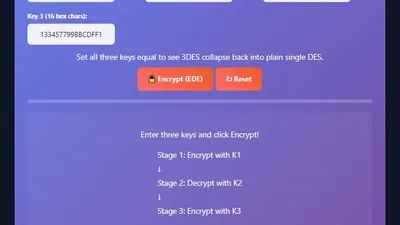
The 3DES (Triple DES) Algorithm
DES's 56-bit key became too weak, but the industry didn't design a new cipher. It just ran DES three times. Learn how Triple DES extended the life of the original standard for another two decades.
CATEGORY
Showing 16 post(s) in this category.
DES's 56-bit key became too weak, but the industry didn't design a new cipher. It just ran DES three times. Learn how Triple DES extended the life of the original standard for another two decades.
ARIA is South Korea's national block cipher, a close cousin of AES that shares its S-box but mixes bytes with a different, self-inverse diffusion layer. Learn how its alternating rounds, key schedule, and 1/π constants work.
Bruce Schneier designed Blowfish as a free, fast alternative to DES, with a distinctive twist: its own S-boxes are generated from the encryption key itself. Learn how it works and why it's still found in legacy systems today.
Camellia is the cipher that stands next to AES in international standards. Learn how this Japanese Feistel design combines byte S-boxes, a linear mixing layer, and key-dependent FL layers to match AES-level security.
CAST-128, also called CAST5, was the default cipher in some versions of PGP and GnuPG. Learn how its three alternating round functions, huge 8x32-bit S-boxes, and key-dependent rotations work, and why its 64-bit block now limits it.
The Data Encryption Standard ruled cryptography for over two decades. Learn how its Feistel network works, why its 56-bit key ultimately doomed it, and why it still matters as the foundation for 3DES and AES.
GOST 28147-89 was the Soviet Union's answer to DES. Learn how its 32-round Feistel design works, why the standard left the S-boxes undefined, and how the modern Magma cipher fixed that.
IDEA was one of the first ciphers to mix three completely different mathematical operations within a single round. Learn how this Swiss-designed algorithm became a mainstay of early PGP, and why it eventually gave way to AES.
RC5 and RC6 are built from just three operations: addition, XOR, and rotations whose amounts come from the data itself. Learn how Ron Rivest's flexible RC5 led to RC6, an AES finalist.
Serpent finished second in the AES competition, and it was built to be the safest finalist. Learn how 32 rounds of tiny S-boxes and a bitslice design traded speed for one of the largest security margins of any block cipher.
Simon and Speck are two lightweight block ciphers released by the NSA in 2013 for tiny devices. Learn how Simon gets by on AND, rotate, and XOR, how Speck uses add, rotate, and XOR, and why they became some of the most debated ciphers ever published.
Skipjack was the secret NSA cipher inside the Clipper chip, declassified in 1998. Learn how its 32 rounds of alternating rules work on four 16-bit words, and why its 80-bit key and its history make it a cautionary tale.
SM4 is China's national block cipher standard, a 32-round design that updates one 32-bit word at a time. Learn how its byte S-box, rotate-and-XOR mixing, and compact key schedule work, and where the cipher is used.
TEA is a block cipher small enough to write in a few lines of code, and XTEA is its repaired successor. Learn how shifts, additions, and XORs make a working cipher, and how a flaw in TEA's key handling led to a famous console hack.
Threefish is the tweakable block cipher inside the Skein hash function, a SHA-3 finalist. Learn how it builds a strong cipher from just addition, rotation, and XOR on 64-bit words, with no S-boxes at all.
Twofish was Bruce Schneier's answer to Blowfish's biggest weakness, and one of the five finalists in the competition that ultimately chose AES. Learn how its Feistel network, PHT mixing, and key-dependent S-boxes work.