Tag Archive

#Cryptography

Found 62 articles with this tag.

Block Ciphers Intermediate

The 3DES (Triple DES) Algorithm

DES's 56-bit key became too weak, but the industry didn't design a new cipher. It just ran DES three times. Learn how Triple DES extended the life of the original standard for another two decades.
The ADFGVX Cipher

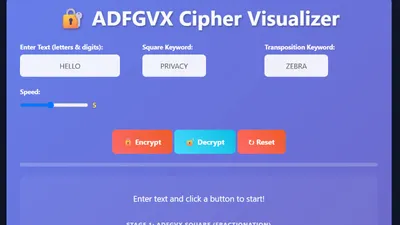
Learn about ADFGVX, the German WWI field cipher that combined Polybius-square fractionation with columnar transposition. It was considered so strong that French cryptanalyst Georges Painvin needed weeks to break a message that helped stop a 1918 offensive.

AES

AES secures nearly everything: HTTPS traffic, encrypted disks, and government secrets alike. Here's how the Rijndael cipher transforms data, round by round.

The Affine Cipher

Learn about the Affine cipher, a generalization of the Caesar cipher that combines multiplication and addition to create a larger, but still breakable, keyspace.

The ARIA Algorithm

ARIA is South Korea's national block cipher, a close cousin of AES that shares its S-box but mixes bytes with a different, self-inverse diffusion layer. Learn how its alternating rounds, key schedule, and 1/π constants work.

Ascon

In August 2025, NIST standardized a cipher small enough to run on a battery-powered sensor and simple enough to fit its whole state in five CPU registers. Learn how Ascon's sponge-based permutation delivers real authenticated encryption at a fraction of AES-GCM's footprint.

The Autokey Cipher

Learn about the Autokey cipher, the Vigenère variant that fixes the repeating-key weakness by folding the plaintext itself into the key stream. That closes the door on Kasiski examination.

Bacon's Cipher

Learn about Bacon's cipher, Francis Bacon's 17th-century biliteral system that hides a secret message not by scrambling it, but by encoding it into which of two typefaces each letter of an innocent-looking cover text uses.

The Bifid Cipher

Learn about the Bifid cipher, Félix Delastelle's fractionating cipher that scrambles a Polybius square's coordinates across an entire message, defeating single-letter frequency analysis far more thoroughly than plain substitution.

Block Ciphers Intermediate

The Blowfish Algorithm

Bruce Schneier designed Blowfish as a free, fast alternative to DES, with a distinctive twist: its own S-boxes are generated from the encryption key itself. Learn how it works and why it's still found in legacy systems today.

The Camellia Algorithm

Camellia is the cipher that stands next to AES in international standards. Learn how this Japanese Feistel design combines byte S-boxes, a linear mixing layer, and key-dependent FL layers to match AES-level security.

Block Ciphers Intermediate

The CAST-128 Algorithm

CAST-128, also called CAST5, was the default cipher in some versions of PGP and GnuPG. Learn how its three alternating round functions, huge 8x32-bit S-boxes, and key-dependent rotations work, and why its 64-bit block now limits it.

Block Ciphers Intermediate

The DES Algorithm

The Data Encryption Standard ruled cryptography for over two decades. Learn how its Feistel network works, why its 56-bit key ultimately doomed it, and why it still matters as the foundation for 3DES and AES.
EdDSA

EdDSA replaced random nonces with deterministic ones, closing off one of ECDSA's worst failure modes. Here's the math behind Ed25519.
The Enigma Machine

Learn how the Enigma machine worked: the WWII German cipher machine that produced a different substitution alphabet for every single keystroke. Its defeat by Alan Turing and Bletchley Park changed the course of the war.

The Four-Square Cipher

Learn about the four-square cipher, a digraph substitution cipher that uses four 5x5 grids to encrypt letter pairs without Playfair's awkward same-row and same-column special cases.
Block Ciphers Intermediate

The GOST 28147-89 Algorithm

GOST 28147-89 was the Soviet Union's answer to DES. Learn how its 32-round Feistel design works, why the standard left the S-boxes undefined, and how the modern Magma cipher fixed that.

HQC (Hamming Quasi-Cyclic)

In March 2025, NIST picked a second code-based algorithm to back up Kyber. This one hides its noise completely differently from McEliece. Learn how HQC masks a public, unscrambled code with pure algebraic randomness instead.

Block Ciphers Intermediate

The IDEA Algorithm

IDEA was one of the first ciphers to mix three completely different mathematical operations within a single round. Learn how this Swiss-designed algorithm became a mainstay of early PGP, and why it eventually gave way to AES.

The McEliece Cryptosystem

McEliece has survived over 45 years of cryptanalysis without ever being broken. It's one of NIST's chosen post-quantum standards. Learn how hiding an error-correcting code behind scrambling matrices creates a public-key system quantum computers can't crack.
MD5

Ronald Rivest designed MD5 in 1991. By 2004 it was broken. Here's the algorithm, and why real collisions ended its cryptographic career.

The Nihilist Cipher

Learn about the Nihilist cipher, the 19th-century Russian revolutionary cipher that turns a Polybius square into a polyalphabetic system by adding coordinate numbers together instead of shifting letters.

The One-Time Pad

Learn about the one-time pad, the only cipher in this series that is mathematically proven unbreakable, and why that proof rests on three conditions that are almost impossible to satisfy in practice.

The RC4 Stream Cipher

RC4 was the simplest, fastest cipher of its era. It powered SSL, WEP, and WPA for over a decade before a decade of accumulating bias attacks quietly killed it. Learn how it works and exactly why it's insecure today.

Block Ciphers Intermediate

The RC5 and RC6 Algorithms

RC5 and RC6 are built from just three operations: addition, XOR, and rotations whose amounts come from the data itself. Learn how Ron Rivest's flexible RC5 led to RC6, an AES finalist.

RSA

RSA made public-key cryptography practical for the world. Here's how it works, why it's secure, and where it's headed as quantum computing looms.

Stream Ciphers Intermediate

Salsa20 and ChaCha20

Designed by Daniel J. Bernstein as a fast, secure, RC4-free alternative for software encryption, ChaCha20 now secures TLS 1.3 and WireGuard alike. Learn how its add-rotate-XOR "quarter round" builds a full cipher from pure arithmetic.

Schnorr Signatures

Schnorr signatures are what DSA might have been if a 20-year patent hadn't gotten in the way. Simpler, provably secure, and now at the heart of Bitcoin's Taproot upgrade: here's how they work.

The Serpent Algorithm

Serpent finished second in the AES competition, and it was built to be the safest finalist. Learn how 32 rounds of tiny S-boxes and a bitslice design traded speed for one of the largest security margins of any block cipher.

Hash Functions Intermediate

SHAKE128 and SHAKE256

Most hash functions give you a fixed-size output no matter what you ask for. SHAKE breaks that rule: it's a hash function you can ask for any amount of output from, built from the same Keccak sponge as SHA-3.

Block Ciphers Intermediate

The Simon and Speck Algorithms

Simon and Speck are two lightweight block ciphers released by the NSA in 2013 for tiny devices. Learn how Simon gets by on AND, rotate, and XOR, how Speck uses add, rotate, and XOR, and why they became some of the most debated ciphers ever published.

Block Ciphers Intermediate

The Skipjack Algorithm

Skipjack was the secret NSA cipher inside the Clipper chip, declassified in 1998. Learn how its 32 rounds of alternating rules work on four 16-bit words, and why its 80-bit key and its history make it a cautionary tale.

Block Ciphers Intermediate

The SM4 Algorithm

SM4 is China's national block cipher standard, a 32-round design that updates one 32-bit word at a time. Learn how its byte S-box, rotate-and-XOR mixing, and compact key schedule work, and where the cipher is used.

The TEA and XTEA Algorithms

TEA is a block cipher small enough to write in a few lines of code, and XTEA is its repaired successor. Learn how shifts, additions, and XORs make a working cipher, and how a flaw in TEA's key handling led to a famous console hack.

The Threefish Algorithm

Threefish is the tweakable block cipher inside the Skein hash function, a SHA-3 finalist. Learn how it builds a strong cipher from just addition, rotation, and XOR on 64-bit words, with no S-boxes at all.

The Two-Square Cipher

Learn about the two-square cipher, a digraph substitution cipher that sits between Playfair's single grid and four-square's four grids: two independently keyed squares, one uniform encryption rule.

Block Ciphers Intermediate

The Twofish Algorithm

Twofish was Bruce Schneier's answer to Blowfish's biggest weakness, and one of the five finalists in the competition that ultimately chose AES. Learn how its Feistel network, PHT mixing, and key-dependent S-boxes work.